K400 Plus Honest Review — Is the Hype Justified?
Introduction
I've been using the K400 Plus for several months as my go-to keyboard for the living room, occasional casual work on the couch, and controlling a Raspberry Pi media center. I bought it because I wanted a simple, all-in-one wireless keyboard with a built-in touchpad — something compact that would let me navigate a TV or small PC without juggling a separate mouse.
What I found was a product that nails the fundamentals at a very accessible price, but also makes a few compromises you should know about before buying. In this review I’ll walk through my day-to-day experience, the things I really liked, the frustrations that crept up over time, and where the K400 Plus fits among other small wireless keyboards.
What I tested it with
To get a realistic sense of how the K400 Plus performs in different scenarios, I used it with:
- A Windows 10 laptop (for typing and productivity tests)
- An Android TV-based smart TV (for streaming and home theater navigation)
- A Raspberry Pi running a media center OS (for couch control and light browsing)
Testing across these devices helped me evaluate typing comfort, touchpad responsiveness, compatibility quirks, and wireless reliability.
Design and build
Out of the box, the K400 Plus feels light and plasticky, but not cheaply so. The layout is compact without being cramped: it keeps most of the essential keys, a row of multimedia shortcuts, and a built-in touchpad on the right. I appreciated the slightly contoured keys and the low profile — typing for longer stretches wasn't uncomfortable, though this is not a mechanical or high-travel keyboard by any stretch.
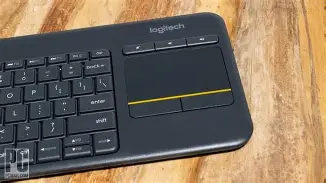
One design detail I liked was the integrated palm rest area. It's not a soft cushion, but the extended chassis gives my hands a stable place to rest when I'm typing on the couch. The touchpad is surrounded by left and right mouse buttons which feel sturdy and distinct — useful when you're using it in the dark with a TV.
Build quality is solid enough for regular living-room use. There are no squeaks or flex that bothered me, but if you tend to be rough with peripherals, keep expectations moderate: this is designed for convenience and portability, not heavy-duty desk pounding.
Typing experience
Typing on the K400 Plus is what you'd expect from a slim membrane keyboard: quiet, with short travel and a soft bottom-out. I was able to write emails and notes without major issues, and the keys have a forgiving, familiar layout that makes the transition painless.
That said, I do notice a few limitations after longer typing sessions. The keys have minimal tactile feedback compared to a full-sized desktop keyboard, and the spacing around some keys (especially the arrow cluster and right side) feels tighter than I’d like. If you do a lot of heavy typing or touch-typing at high speed, you may find your accuracy slightly reduced until you adapt.
Touchpad and gestures
The built-in touchpad is the K400 Plus’s defining feature for me. It's compact but responsive, and for basic navigation — moving a cursor, clicking links, scrolling simple pages — it does the job very well. The two physical mouse buttons flanking the touchpad are easy to use and register clicks reliably.
There are a few trade-offs though. The touchpad is small, so complex multi-finger gestures or precise cursor control (for light photo editing or precision design work) are not comfortable. Scrolling works, but it isn't as smooth as using a full-sized touchpad or dedicated mouse wheel. I also noticed that gesture support varies by device: on my Windows laptop I had more predictable behavior than on the smart TV, where some gestures were ignored depending on the TV’s firmware.
Looking for the best Electronics deals on Amazon?
Browse Now →Media keys and living-room use
One thing that pleasantly surprised me was how convenient the media keys are for living-room use. Volume controls, play/pause, and home/search keys made it easy to control streaming apps without switching remotes. The function row doubles as media keys, and I found myself relying on them often when navigating streaming apps on the TV.
In my experience, the K400 Plus is especially well-suited for media-center setups where you want a single device to replace both a keyboard and a basic remote. Typing search queries on a streaming platform felt less painful than using an on-screen keyboard with a remote.
Wireless performance and battery life
The K400 Plus uses a small USB wireless receiver that plugs into a free USB port on the host device. Range was very good in my tests: I could comfortably use it from across a medium-sized living room without dropouts. Latency is low enough for everyday tasks and media navigation, but I wouldn’t call it ideal for competitive gaming.
Battery life is a major plus. The advertised longevity is long, and after several months of moderate use I’m still on the original batteries with no noticeable degradation. In practice, if you’re using the keyboard primarily for TV and casual browsing, you can reasonably expect months of life between battery changes.
A note on the receiver: because the keyboard relies on that USB dongle, you’ll need an available USB-A port on the device you want to pair. If you use a TV or device with only USB-C or no USB ports, a small adapter or a powered USB hub becomes necessary.
Compatibility and quirks
In my testing, the K400 Plus worked well with Windows and Android TV devices. Setup is plug-and-play — plug the USB receiver in and the keyboard and touchpad are ready. However, I did encounter small quirks with some smart TVs where certain keys or gestures behaved differently. Some TV platforms map remote keys in unexpected ways, so the exact behavior will depend on your TV’s software.
Also, this model doesn’t offer multi-device Bluetooth switching. If you frequently switch control between a phone, laptop, and TV, that limitation may be a deciding factor. For single-device living-room use or occasional laptop pairing via the USB dongle, it’s a non-issue.
Durability and long-term impressions
After months of daily living-room use the K400 Plus still looks and behaves much like the day I bought it. The printed legends on the keys show normal signs of use but no fading yet, and the chassis is free of scratches from careful handling. If you're treating it as a casual, portable living-room keyboard it should hold up well.
That said, if you plan to carry it around in a backpack with other items or use it outdoors, its lightweight plastic construction means it’s not as rugged as higher-end keyboards. Keep it in a small sleeve if you travel with it frequently.
Pros & Cons
- Pros:
- All-in-one keyboard + touchpad design — great for living-room and media center use
- Compact, lightweight, and comfortable for casual typing
- Reliable wireless range with plug-and-play USB receiver
- Long battery life in real-world use
- Dedicated media keys that are useful with smart TVs
- Cons:
- No backlighting — makes it harder to use in very dark rooms
- Touchpad is small and not ideal for precision cursor work
- Lacks multi-device Bluetooth switching — tied to USB receiver for pairing
- Membrane keys with short travel — not ideal for heavy typists
- Some smart TVs show inconsistent gesture/key behavior depending on firmware
Comparison: K400 Plus vs similar options
For context, here’s a short comparison between the K400 Plus and two common alternatives I considered: a higher-end backlit living-room keyboard and a compact Bluetooth keyboard.
| Feature | K400 Plus | Logitech K830 (Backlit alternative) | Generic Compact Bluetooth Keyboard |
|---|---|---|---|
| Input method | Keyboard + built-in touchpad (USB receiver) | Keyboard + larger touchpad (rechargeable, backlit) | Keyboard only (often no touchpad) or limited touch area (Bluetooth) |
| Backlight | No | Yes | Depends on model (usually no) |
| Wireless pairing | 2.4 GHz USB dongle (plug-and-play) | 2.4 GHz + rechargeable battery (some models also Bluetooth) | Bluetooth (multi-device depends on model) |
| Battery | Removable batteries — very long life | Rechargeable (faster drain due to backlight) | Rechargeable or replaceable depending on model |
| Price | Budget-friendly | Premium | Varies (budget to mid-range) |
| Best for | Casual living-room typing & TV control | Users who want backlight and a sleeker touchpad | Users wanting wireless typing across multiple Bluetooth devices |
Buying guide — Is the K400 Plus right for you?
Here are the main factors I considered while choosing the K400 Plus, and how you can decide whether it fits your needs.
Shop the latest Electronics picks on Amazon.
Shop Amazon →1. Do you need a touchpad or a separate mouse?
If you want a single device to replace keyboard plus mouse for a media center or TV, the K400 Plus’s integrated touchpad is a huge convenience. If you need precise pointer control (photo editing, CAD, competitive gaming), a dedicated mouse will serve you better.
2. Does your device have a free USB-A port?
The K400 Plus requires a USB dongle. Most smart TVs and mini-PCs have at least one USB-A port, but some modern ultrabooks and tablets only have USB-C. If your device lacks USB-A, plan for an adapter or hub.
3. Is backlighting important?
If you frequently type in the dark, the K400 Plus’s lack of backlighting can be annoying. Consider a backlit alternative if you need keys visible in low light.
4. How often do you switch between devices?
If you regularly switch control between your phone, laptop, and TV, a Bluetooth keyboard with multi-device switching is more convenient. The K400 Plus is ideal if you primarily use one device (like a TV or a single PC) with occasional swaps.
5. Do you prefer long battery life or rechargeable convenience?
The K400 Plus uses replaceable batteries and lasts a long time between changes. If you prefer recharging instead of replacing batteries, look at rechargeable models — but expect shorter time between charges if they include features like backlighting.
6. Comfort and typing style
If you type a lot and want a tactile, comfortable experience, consider testing similar keyboards in person. The K400 Plus is comfortable for casual and medium-length typing sessions but is not meant to replace a dedicated desktop keyboard for heavy typing.
Final thoughts and conclusion
After several months with the K400 Plus, I'm convinced it delivers exactly what it promises: a straightforward, reliable, and inexpensive way to control a TV or small PC without needing a separate mouse. What I appreciated most was the convenience — the integrated touchpad and media keys made living-room navigation far less clunky than using a remote. The wireless range and battery life were strong practical wins in everyday use.
At the same time, the K400 Plus isn’t perfect. The small touchpad and lack of backlighting are meaningful downsides for some users, and the membrane keys won't satisfy heavy typists looking for a premium desk-keyboard feel. Also, the dependence on a USB receiver is something to keep in mind if your devices lack free USB-A ports.
In my experience, the hype around the K400 Plus is largely justified if your priorities are convenience, long battery life, and a simple plug-and-play experience for a single living-room device. If you need multi-device switching, backlighting, or precision pointing, look at higher-end alternatives. For my use — a couch-friendly keyboard that works with my TV and Raspberry Pi — it hit the sweet spot: uncomplicated, dependable, and very practical.